

Feed Pellet Machine in Kenya: Market & Buying Guide
A 50 kg bag of layer mash that cost about $14 five years ago now sells for around $32. Here is why Kenyan producers are pelleting their own feed - and how to choose the right machine.
Feed prices in Kenya have risen by more than 37 percent between 2020 and 2025. Feed already accounts for 65 to 80 percent of poultry production cost, and Kenya National Bureau of Statistics data show the commercial broiler population falling by more than 8 percent in 2024 - a decline the industry attributes largely to the cost of feed.
It is the one expense a farmer can actually attack - not by negotiating harder with the mill, but by cutting the mill out of the daily equation and producing pellets on the farm. This guide covers the Kenyan market, machine types suited to Kenyan farms, indicative prices in KSh, import compliance, and how to match a machine to whether you keep layers in Kiambu, dairy cows in the Rift Valley, or fish ponds near Lake Victoria.
Part of a series. This is one of our market guides. For the full picture of every machine in a feed line - grinding, chopping, mixing, pelleting, drying and storage - read the Animal Feed Processing Equipment complete guide.
Kenya's Feed Market at a Glance
Kenya's compound feed industry has an installed capacity of roughly 1.6 million tonnes per year, but actual production runs at only 40 to 60 percent of that figure - around 700,000 to 800,000 tonnes - according to USDA Foreign Agricultural Service analysis. Poultry feed accounts for about 41 percent of output, the largest single category, with dairy feed second.
| Market fact | Figure | Why it matters to you |
|---|---|---|
| Installed milling capacity | approx. 1.6 million t/year | Runs at only 40-60%, so supply is tight when demand spikes |
| Registered feed mills | approx. 307 | Around 90% are small-scale - the market is fragmented |
| Largest two producers | 50%+ of poultry feed | Concentrated pricing power at the top |
| Layer mash, 50 kg | approx. $14 to $32 over five years | The cost curve that pushes farmers to self-produce |
| Feed share of poultry cost | 65-80% | The single biggest lever on your margin |
The Competition Authority of Kenya has flagged feed prices as high relative to international benchmarks, driven by maize and soybean meal costs and import constraints. The protein side is the pressure point: AKEFEMA has repeatedly noted that around 80 percent of protein ingredients are imported, mainly from Tanzania, Uganda, Malawi and Zambia.
Market figures are drawn from published industry and USDA FAS analysis and move with season and policy. The government has approved zero-rated importation of yellow maize, soybeans and oil cakes and launched a ten-year National Feed Strategy. Confirm current prices locally before you build a budget.
Raw Materials You Can Source in Kenya
Most ration ingredients are available inside the country:
- Maize - the energy base, priced seasonally; maize germ from local millers is cheaper than whole grain.
- Soybean meal and sunflower cake - the main protein sources, with imported soybean meal among the costliest inputs.
- Wheat bran and wheat pollard - fibre and energy from local millers.
- Omena (silver cyprinid) fish meal from Lake Victoria - the traditional protein, though the price swings with the lake harvest.
- Meat and bone meal - increasingly promoted as a local alternative to imported protein.
- Napier grass and maize stover - the forage base for dairy rations.
- Lime or oyster shell, salt and premix - minerals, non-negotiable for layers.
Buy in bulk at harvest and store dry. Above about 14 percent moisture, material smears in the die instead of pelleting - dry it first with a mobile grain dryer if you buy straight from the field.
Types of Feed Pellet Machines for Kenyan Farms
Flat die pellet machines
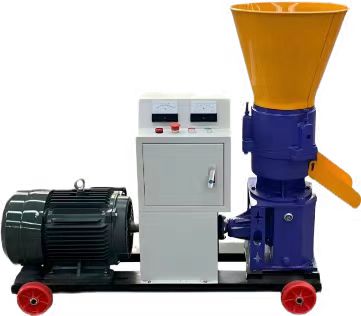
Capacities of roughly 80 to 500 kg/h, compact, and - importantly for Kenya - available in single-phase 240 V versions that run on ordinary household wiring. For a layer operation in Kiambu or Nakuru this is the standard starting point. Our flat die feed pellet machine covers the 100 to 500 kg/h band with 2 to 6 mm die options.
Ring die pellet machines
Tonne-per-hour class machines with conditioners, built for continuous commercial output. Kenyan feed mills use exactly this class of equipment to stabilise layer feed lines and cut fines at the cooler.
Fish feed extruders
Aquaculture around Lake Victoria and pond systems countrywide runs on floating feed, which requires a single-screw or twin-screw extruder rather than a pellet press. If you feed fish, say so before you order - a standard pellet machine will not make floating feed.
Match the Machine to Your Region
- Poultry belts (Kiambu, Nakuru): a small flat die machine for on-farm rations. Farms feeding 1,000+ birds typically justify the 150 kg/h class and up.
- Rift Valley dairy units: a pellet machine paired with a chaff cutter for chopping Napier grass before pelleting - the forage side is where savings compound.
- Lake Victoria fish ponds: a single-screw extruder for floating feed, sized to your pond stocking.
- Small feed mill ventures: a complete line - grinder, mixer, pellet mill, cooler - if you intend to sell feed, not just make it.
Remember the step before pelleting: grain must be ground and roughage chopped. Our guide on why chaff cutting comes before the pellet machine explains the sequence and why it protects your die.
Feed Pellet Machine Prices in Kenya
Indicative market prices seen from local dealers and equipment importers:
| Machine class | Indicative price |
|---|---|
| Small combined grinder-mixer units | approx. KSh 45,000 |
| 150 kg/h flat die pellet machines | approx. KSh 125,000 |
| Larger imported pellet machines | KSh 258,800 - 1,294,000 |
| Complete feed production plants | from KSh 3,000,000 |
These figures move with the exchange rate and configuration, so use them to frame a budget - then compare quotes on spares, warranty and support rather than sticker price alone.
What Does It Cost to Run, and When Does It Pay Back?
The saving is the gap between your own production cost per kilo and the bagged feed price you pay today, multiplied by your monthly tonnage.
| Example | 5,000 layers | 2,000 layers |
|---|---|---|
| Feed per day | about 575 kg | about 230 kg |
| Feed per month | about 17 tonnes | about 7 tonnes |
| Assumed saving per kg | KSh 8 - 15 | KSh 8 - 15 |
| Monthly saving | KSh 136,000 - 255,000 | KSh 56,000 - 105,000 |
Illustrative only. Your saving depends on your formulation, your raw material buying power and the bagged feed price in your county. Compare it against the landed cost of the mill and grinder - operations of this size usually recover the equipment within the first year.
Import Compliance: KEBS PVoC, Duty and Shipping
This is where first-time importers lose money. Kenya runs a mandatory Pre-Export Verification of Conformity (PVoC) programme under the Kenya Bureau of Standards, and machinery falls inside its scope.
- Get the Certificate of Conformity before shipment. Without one, goods face destination inspection, charges and possible rejection. Start the paperwork three to four weeks before the vessel sails.
- Issued by KEBS-appointed agents such as SGS, Intertek, Cotecna and Bureau Veritas in the country of export. Route A suits occasional shipments; Routes B and C suit repeat exporters.
- Documents typically needed: commercial invoice, packing list, Import Declaration Form, certificate of origin, English manuals and technical files.
- Budget for: import duty under the EAC Common External Tariff for the relevant HS line, VAT, Import Declaration Fee and Railway Development Levy. Rates change with the budget, so confirm with KRA or your clearing agent.
- Logistics: sea transit from Chinese ports to Mombasa is typically 25 to 35 days, then clearance, then the standard gauge railway to the Nairobi inland container depot for upcountry delivery. Ask for a CIF Mombasa quote so you can compare suppliers on the same basis.
Ask your supplier two questions before paying: can they support the PVoC inspection in China, and will they supply English manuals, electrical drawings and nameplate data? A supplier who has shipped to Kenya before answers both without hesitation.
Buying Checklist
- Spare parts. Dies and rollers wear. Confirm a supply route before purchase, and ship a spare set in the first crate.
- Warranty terms - in writing, with what is actually covered.
- Local dealer or direct import. Dealers offer installation and support at a markup; direct factory import cuts cost but puts commissioning on you.
- Power. Single-phase 240 V machines suit farm wiring; larger machines need three-phase 415 V or a generator plan.
- Standards. If you will sell feed commercially, KEBS requirements for feed quality and labelling apply - build them into planning from the start.
Frequently Asked Questions
How much does a feed pellet machine cost in Kenya?
Budget about KSh 45,000 for a small combined grinder-mixer, around KSh 125,000 for a 150 kg/h flat die machine, KSh 258,800 to KSh 1,294,000 for larger imported machines, and from KSh 3,000,000 for a complete line. Landed cost adds freight, insurance, PVoC, duty, VAT, IDF and RDL plus inland transport - ask for a CIF Mombasa quote.
Which machine do I need for dairy cattle vs poultry?
Dairy rations and forage pellets call for 4 to 6 mm dies and enough torque for fibrous material, and Napier grass must be chopped first. Poultry needs finer grinding and 2 to 4.5 mm dies. One flat die machine can serve both with a die change, but forage work is harder on the machine.
Should I buy from a local dealer or import directly?
Local dealers give you installation, training and someone to call - worth the premium for first-time buyers. Direct factory import costs less and widens machine choice, but you arrange commissioning and carry the troubleshooting yourself.
Can I pelletize Napier grass for my dairy cows?
Yes - it is established practice in Kenyan dairy systems. Chop the grass with a chaff cutter, mix with concentrate and molasses, and pellet at 4 to 6 mm. The result stores better than loose forage and cuts waste at the trough.
Do I need a grinder or chaff cutter before pelleting?
Yes. Whole grain and unchopped forage block the die and wear the rollers. The sequence is chop, grind, mix, then pellet - here is why chaff cutting comes first.
Can I run a pellet mill without three-phase power?
Yes, but plan it. Options are a diesel engine drive, a correctly sized generator, or a single-phase unit for the smallest capacities - several flat die machines run on ordinary 240 V household wiring.
Do I need KEBS certification to import a pellet mill?
Yes. Machinery falls inside the KEBS PVoC programme and a Certificate of Conformity is issued before shipment by an appointed inspection agent. Shipping without one risks destination inspection, penalties and possible rejection.
Related Reading
Planning a Pellet Line in Kenya?
Tell us your flock or herd size, raw materials and power supply. We will size the mill, quote CIF Mombasa, and support the KEBS PVoC inspection before shipment.
Request a Kenya Quote