

Feed Pellet Machine in Nigeria: Market & Buying Guide
Maize nearly doubled in twelve months and the poultry industry lost about 45 percent of its value. Here is what that means for Nigerian producers - and how to buy a pellet machine that survives the grid, the ports and the paperwork.
Nigeria's poultry sector is the largest in West Africa and the most exposed to input shocks. A tonne of maize that sold for about N480,000 a year ago traded near N910,000 in recent market surveys - an increase close to 90 percent. Soybean meal moved from roughly N425,000 to N714,000 over the same period.
Sunday Ezeobiora, president of the Poultry Association of Nigeria, has put the cumulative damage in plain terms: record maize and soybean prices shrank industry value by about 45 percent, from roughly N10 trillion in 2022 to about N5.5 trillion now. With feed at 60 to 70 percent of production cost - above 80 percent in some flocks - producing your own pellets has moved from optimisation to survival.
Part of a series. This is one of our market guides. For every machine in a feed line - grinding, chopping, mixing, pelleting, drying and storage - read the Animal Feed Processing Equipment complete guide.
The Nigeria Feed Market in 2026
| Market fact | Figure | Why it matters to you |
|---|---|---|
| Maize price movement | N480,000 to about N910,000 per tonne | Energy base of almost every ration nearly doubled |
| Soybean meal | N425,000 to about N714,000 | The protein side moved with it |
| Industry value | About N10tn (2022) to N5.5tn | Shrinking sector means consolidation and closures |
| Feed share of cost | 60-70%, above 80% in some flocks | The only lever big enough to matter |
| Day-old chick supply | Hatchery bookings up to 5 months | Plan expansion well ahead - birds are the bottleneck |
The arithmetic on a single flock is stark: raising 2,000 broilers now takes roughly 280 bags of feed at about N27,800 per bag - close to N7.8 million in feed alone before labour, power or medication. Nigerian consumers eat about 2 kg of chicken per person per year against a global average near 17 kg, so the demand side is not the problem. Cost is.
Figures come from published market surveys and Poultry Association of Nigeria statements. They move quickly with the naira and with harvest cycles - confirm local prices before you build a budget.
What Nigerian Producers Actually Feed
- Maize - the energy base, and the input that moved most.
- Soybean meal, groundnut cake and cottonseed cake - the protein options; local sourcing cuts exposure to imported meal.
- Wheat bran, rice bran and maize offal - cheap fibre and energy from local millers.
- Fish meal and blood meal - traditional protein, with catfish processing by-products increasingly used.
- Bone meal, limestone, salt and premix - minerals, essential for layers.
Two Nigeria-specific points. First, catfish farming is large and runs on floating feed, which needs an extruder rather than a pellet press - say so before you order. Second, storage matters: humidity and aflatoxin risk mean drying before grinding is not optional where grain comes in wet. A mobile grain dryer handles that step.
Choosing the Machine: Capacity, then Power
A layer eats roughly 110 to 120 grams a day. Work out your daily requirement and add 20 percent headroom.
| Your stock | Feed per day | Suitable mill capacity |
|---|---|---|
| 500 - 1,500 birds | 60 - 180 kg | 100 - 150 kg/h |
| 1,500 - 5,000 birds | 180 - 600 kg | 200 - 300 kg/h |
| 5,000 - 15,000 birds | 600 kg - 1.8 t | 300 - 500 kg/h |
| Above 15,000 birds | 1.8 t and up | 500 kg/h plus, or two units |
| Catfish ponds, commercial | by stocking density | Floating feed extruder |
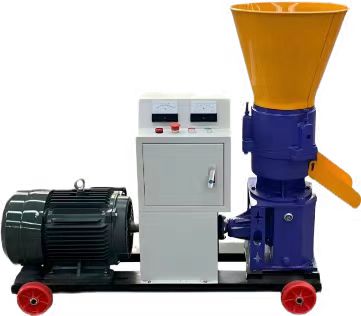
See configurations, die sizes and motor options on the Sunto feed pellet mill page, and compare flat die against ring die in our pellet machine selection guide.
Power Is the First Question, Not the Last
Nigerian supply is nominally 415 V three-phase at 50 Hz, but grid availability is the practical constraint almost everywhere. Before ordering, settle on one of these:
- Diesel engine drive - the most common answer for Nigerian farms, since it removes the grid question entirely.
- Three-phase electric plus a generator - cheapest per tonne where supply is stable, with a genset sized for starting current.
- Single-phase electric - only realistic for the smallest units, and slow.
Tell your supplier your site conditions before you order. A mill that arrives with the wrong motor is expensive and slow to fix once it has cleared at Apapa.
Do Not Skip the Steps Before It
Whole grain blocks the die and wears the rollers. The sequence is chop, grind, mix, then pellet: a feed hammer mill for grain, a chaff cutter for any forage, and a vertical feed mixer to distribute premix evenly. Our guide on why chaff cutting comes first covers the detail.
Import Compliance: SONCAP, Form M and PAAR
Nigeria runs a destination-inspection regime, and the paperwork has to start before the goods ship. Machinery is inside the scope of the Standards Organisation of Nigeria Conformity Assessment Programme (SONCAP).
- Form M. Your Nigerian importer opens a Form M through an authorised dealer bank on the Nigeria Single Window trade portal, with the proforma invoice attached. Without it, nothing downstream can be filed.
- SONCAP, two stages. A Product Certificate (PC) for the product line from an accredited body such as SGS, Intertek or Cotecna, then a SONCAP Certificate (SC) for the specific shipment. A PC alone does not clear goods - the SC is per shipment and references the bill of lading. From 27 March 2026, applications and certificate activation run through the National Single Window.
- PAAR. Nigeria Customs issues a Pre-Arrival Assessment Report that fixes the duty basis before the vessel arrives. Your broker should apply as soon as the bill of lading is issued.
- Clearance. Licensed broker files the entry, duties are paid, goods are released after any examination.
Duty and taxes are calculated on CIF value. The working formula: import duty = CIF multiplied by the HS tariff rate (commonly 5 to 20 percent for machinery); VAT = 7.5 percent of CIF plus duty; plus ECOWAS ETLS levy at 0.5 percent and CISS inspection at roughly 1 percent of FOB. As an illustration, a shipment with a CIF value of $20,000 at a 10 percent tariff carries $2,000 duty, and VAT of 7.5 percent on $22,000 is $1,650 - before port, terminal and broker charges.
Rates are indicative and change with tariff policy and HS classification. Confirm the current line for your machine with your clearing agent before you quote a landed cost. Getting the HS code wrong can trigger reclassification and penalties.
Ports and Transit
Apapa is the largest port and handles breakbulk and out-of-gauge cargo; Tin Can Island is generally faster for standard containerised machinery; Onne suits cargoes destined for the east. Transit from Chinese ports is typically several weeks, and the common causes of demurrage are a missing SC, late PAAR submission, or a mismatch between Form M, invoice and bill of lading. Ask for a CIF quote so you can compare suppliers on the same basis.
What Does It Pay Back?
The saving is the gap between your own cost per kilo and the bagged feed price you pay today, multiplied by your monthly tonnage. On a 5,000-bird layer unit that is roughly 17 tonnes a month; at a conservative N80 to N150 per kg saving, that is N1.36 million to N2.55 million a month before power and labour.
Illustrative only - your result depends on your formulation and your buying power on maize and soya. Set it against the landed cost of the mill and grinder. Nigerian operations commonly recover the equipment within the first year because the input gap is so wide.
Buying Checklist
- Spare dies, rollers, hammers and screens in the first crate. Waiting weeks for a part stops the line.
- Warranty in writing, with what is actually covered.
- Power plan settled before the order - diesel, genset or three-phase.
- Documents match exactly across Form M, invoice, packing list and bill of lading.
- Supplier can support SONCAP with test reports, manuals and nameplate data.
Frequently Asked Questions
How much does a feed pellet machine cost in Nigeria?
Machine price depends on capacity and drive. Landed cost adds freight, insurance, SONCAP certification, import duty on the CIF value, VAT at 7.5 percent, the ETLS levy and CISS inspection, plus port and inland charges. Ask for a CIF quote and a separate duty estimate so you can compare suppliers properly.
Do I need SONCAP to import a pellet mill?
Yes for most machinery. You need a Product Certificate for the product line plus a SONCAP Certificate for the specific shipment, and the SC must be obtained before the vessel sails. Shipping without one is the most common preventable cause of container holds.
What is the difference between Form M and PAAR?
Form M is opened by the importer through an authorised bank and is the entry point for the import. PAAR is issued by Nigeria Customs before arrival and sets the duty basis. You cannot get PAAR without Form M.
Can I run a pellet mill on Nigerian power?
Yes, but plan it deliberately. Most Nigerian farms choose a diesel engine drive to remove grid dependence; others use three-phase with a correctly sized generator. Smallest units can run single phase.
Can I make floating catfish feed with a pellet mill?
No. Floating feed requires an extruder, because the starch must be cooked and expanded. A standard pellet press makes sinking feed only. Tell your supplier which one you need.
Which port should I ship to?
Apapa for oversized and breakbulk cargo, Tin Can Island for standard containerised machinery, Onne for destinations in the east. Your freight forwarder should choose based on the machine dimensions and final delivery point.
Do I need a grinder before the pellet mill?
Yes. Whole grain blocks the die and wears the rollers. The sequence is chop, grind, mix, then pellet - see why chaff cutting comes first.
Related Reading
Planning a Pellet Line in Nigeria?
Tell us your flock size, raw materials and power plan. We will size the mill, quote CIF, and support the SONCAP documentation before shipment.
Request a Nigeria Quote