


How to Choose a Feed Pellet Mill
Electric, diesel or 3-phase? Flat die or ring die? Here is how to match a feed pellet machine to your animals, your power supply and your daily volume — with real photos, diagrams and specs.
A feed pellet mill turns loose grain, meal, grass and crop residues into dense, uniform pellets that livestock eat with far less waste. For many farms it is the single most cost-effective upgrade after buying a chaff cutter. The first question buyers ask is electric or diesel? — but the real fit depends on what you feed, how much, and what power you have. Here is how to choose a feed pellet machine that actually earns its place on your farm.
1. What a Feed Pellet Mill Actually Does for You
Pelleting is not just about shape. The process gelatinizes starch, kills some surface bacteria and parasites, and locks in a consistent ration. The diagram below shows how a flat die machine presses mash through the die holes to form finished pellets:
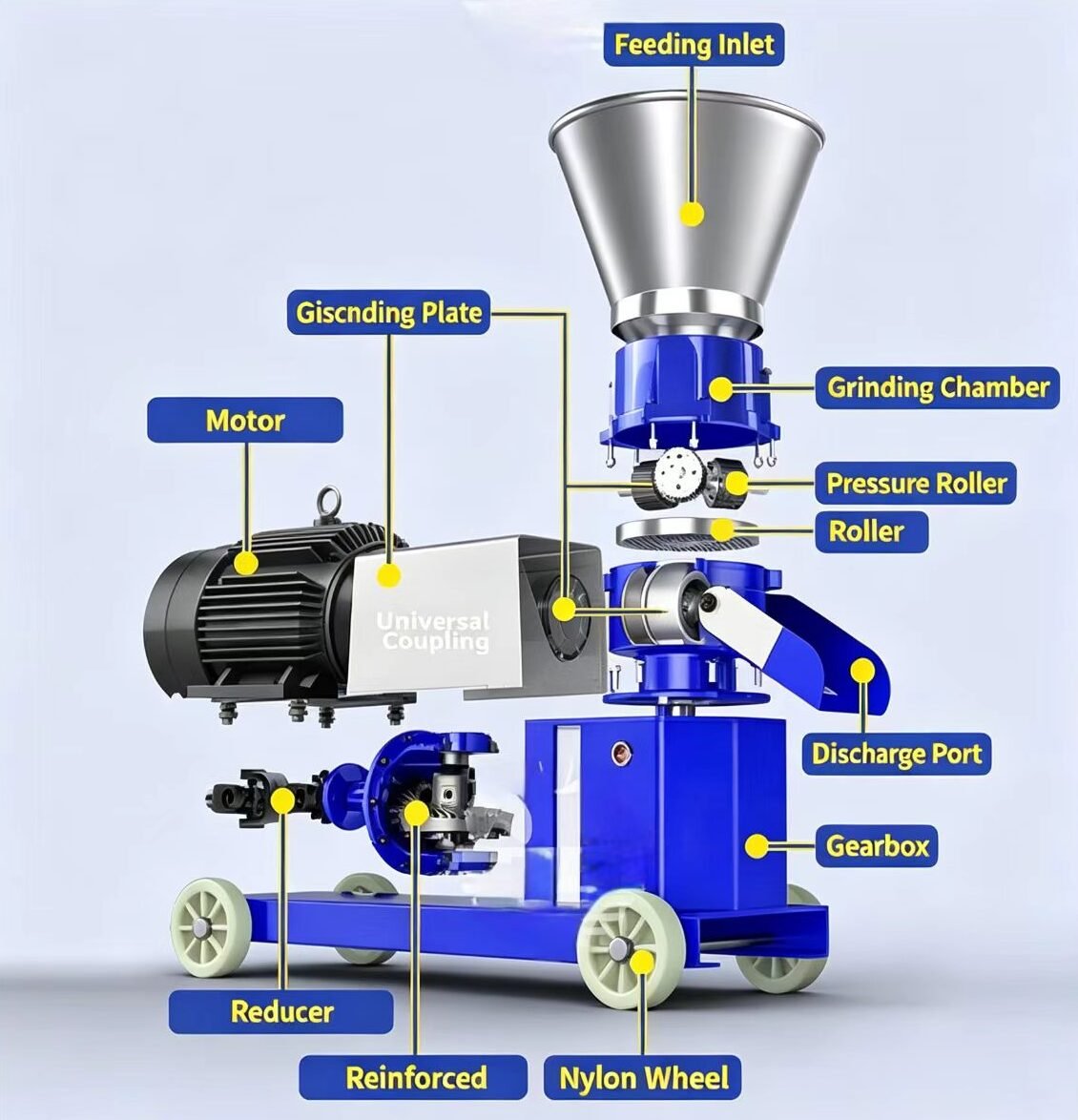
Why pellets beat loose feed
- Less waste. Animals cannot pick and toss ingredients, so feed conversion improves — research and extension guides such as FAO agriculture resources and University of Minnesota Extension consistently report lower feed cost per unit of meat, milk or eggs.
- Better digestibility. Heat and pressure make nutrients more bioavailable, especially for poultry and pigs.
- Storage & transport. Pellets are about one-third the volume of mash, resist caking, and travel well.
- Custom rations. You control the recipe — local maize, soy, alfalfa, molasses — instead of whatever the bagged brand mixes.
2. Electric vs Diesel vs 3-Phase — The Power Decision
This choice shapes everything else. The Sunto KLJ range covers all three, so the question is which matches your site:
Single-phase electric
3-phase electric
Diesel engine
Pick by site
| Power type | Models | Best when | Watch out for |
|---|---|---|---|
| Single-phase electric | KLJ-150 (4 HP), KLJ-160 (5.5 HP) | You have reliable grid power at the barn and run small batches for a few animals. | Outlet amperage must handle the motor; not for remote fields. |
| 3-phase electric | KLJ-210 (10 HP), KLJ-260 (20 HP) | You have 3-phase supply and want higher, steady throughput on the farm. | Needs a 3-phase line or a converter; less portable. |
| Diesel engine | KLJ-300 (30 HP) | You need high output away from power, or no stable electricity on site. | Fuel and engine upkeep; more noise than electric. |
Our take for most small and medium farms
- Single-phase electric is the sweet spot for smallholders — low running cost, quiet, and the KLJ-150/160 cover chickens, rabbits and a few goats easily.
- 3-phase earns its keep at higher volume — the KLJ-210/260 suit cooperatives and mixed livestock farms.
- Diesel (KLJ-300) is the off-grid workhorse when you must hit 800–1000 kg/h without a power line.
3. Flat Die vs Ring Die
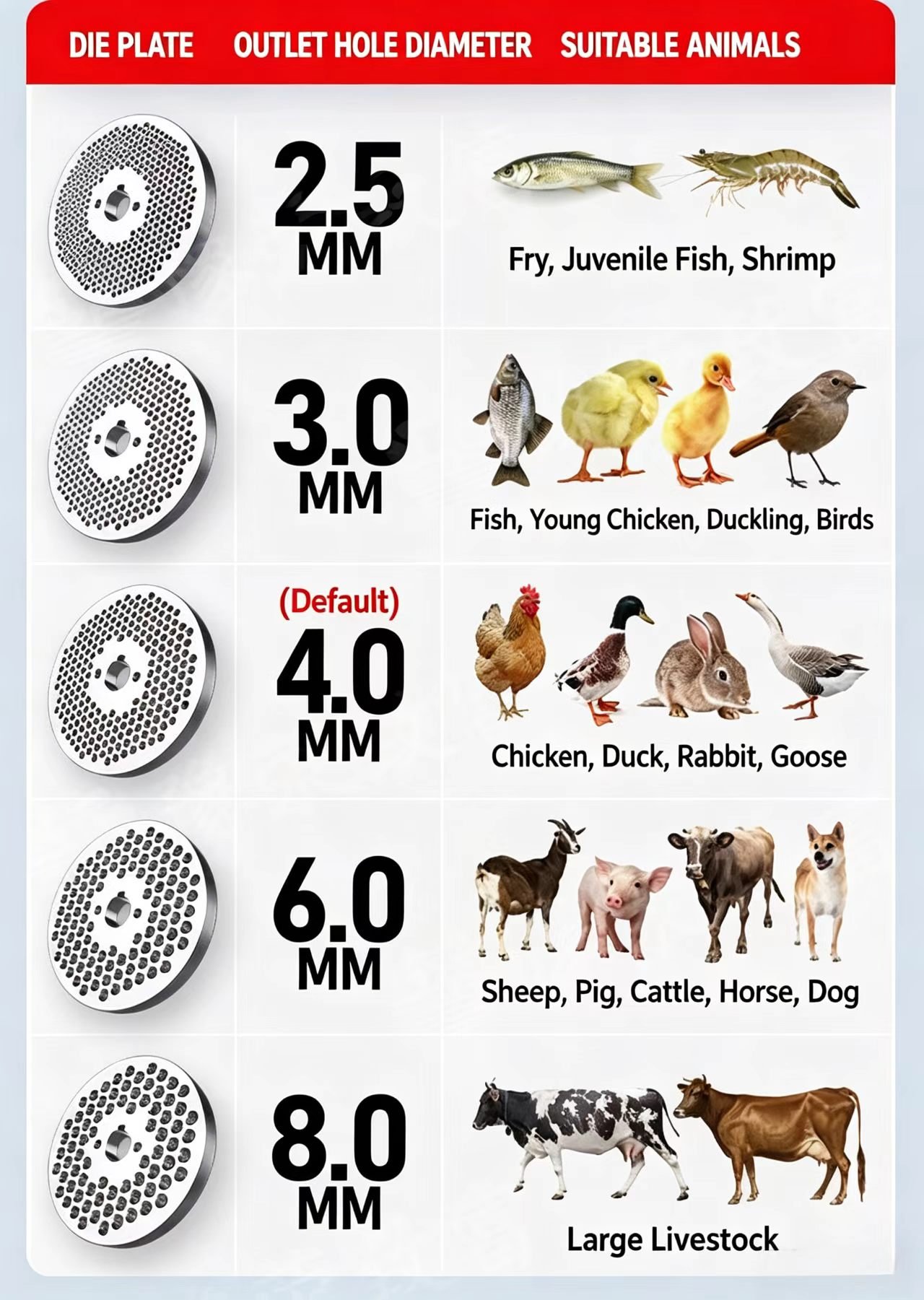
A flat die feed pellet mill (the KLJ design) presses material between a flat rotating die plate and rollers. It is simpler, cheaper to maintain, and ideal for the 80–1000 kg/h range most farms need. Ring die machines dominate large commercial feed factories (several tonnes per hour) but cost far more and need a full production line. For on-farm and small-batch feed, flat die is the right call — and it is exactly what our KLJ series uses.
Flat die (KLJ design)
Ring die (factory scale)
4. The Specs That Decide the Fit
Once power is settled, the spec table tells you whether a machine handles your daily volume. These are the verified Sunto KLJ figures:
| Spec | KLJ-150 | KLJ-160 | KLJ-210 | KLJ-260 | KLJ-300 |
|---|---|---|---|---|---|
| Motor | 4 HP 1-phase | 5.5 HP 1-phase | 10 HP 3-phase | 20 HP 3-phase | 30 HP diesel |
| Capacity | 80–150 kg/h | 100–200 kg/h | 150–300 kg/h | 350–500 kg/h | 800–1000 kg/h |
| Rollers | 2 pcs | 3 pcs | 2 pcs | 3 pcs | 4 pcs |
| Pellet size | 3/4/6 mm | 3/4/6 mm | 3/4/6/8 mm | 3/4/6/8 mm | 3/4/6/8 mm |
| Weight (w/ motor) | 85 kg | 90 kg | 165 kg | 260 kg | 380 kg |
| HS Code | 84361000 | 84361000 | 84361000 | 84361000 | 84361000 |
Pick the row where capacity covers your herd at peak demand with a little headroom — a small chicken flock sits comfortably on a KLJ-150, while a dairy-and-beef mix pushing 800 kg/h belongs on the KLJ-300.
5. How to Make Your Own Animal Feed Pellets
The workflow is the same on every flat die machine. Follow the five steps below:
Grind
Crush grain, straw or meal to pass a 1.5 mm screen for even pressing.
Mix
Blend energy, protein and minerals by species; add oil as binder if dry.
Moisten
Aim for 12–18% moisture — too dry crumbles, too wet stays soft.
Pelletize
Feed mash into the hopper; die and rollers form and cut pellets.
Cool & bag
Air-cool, then store dry. Pellets keep far longer than mash.
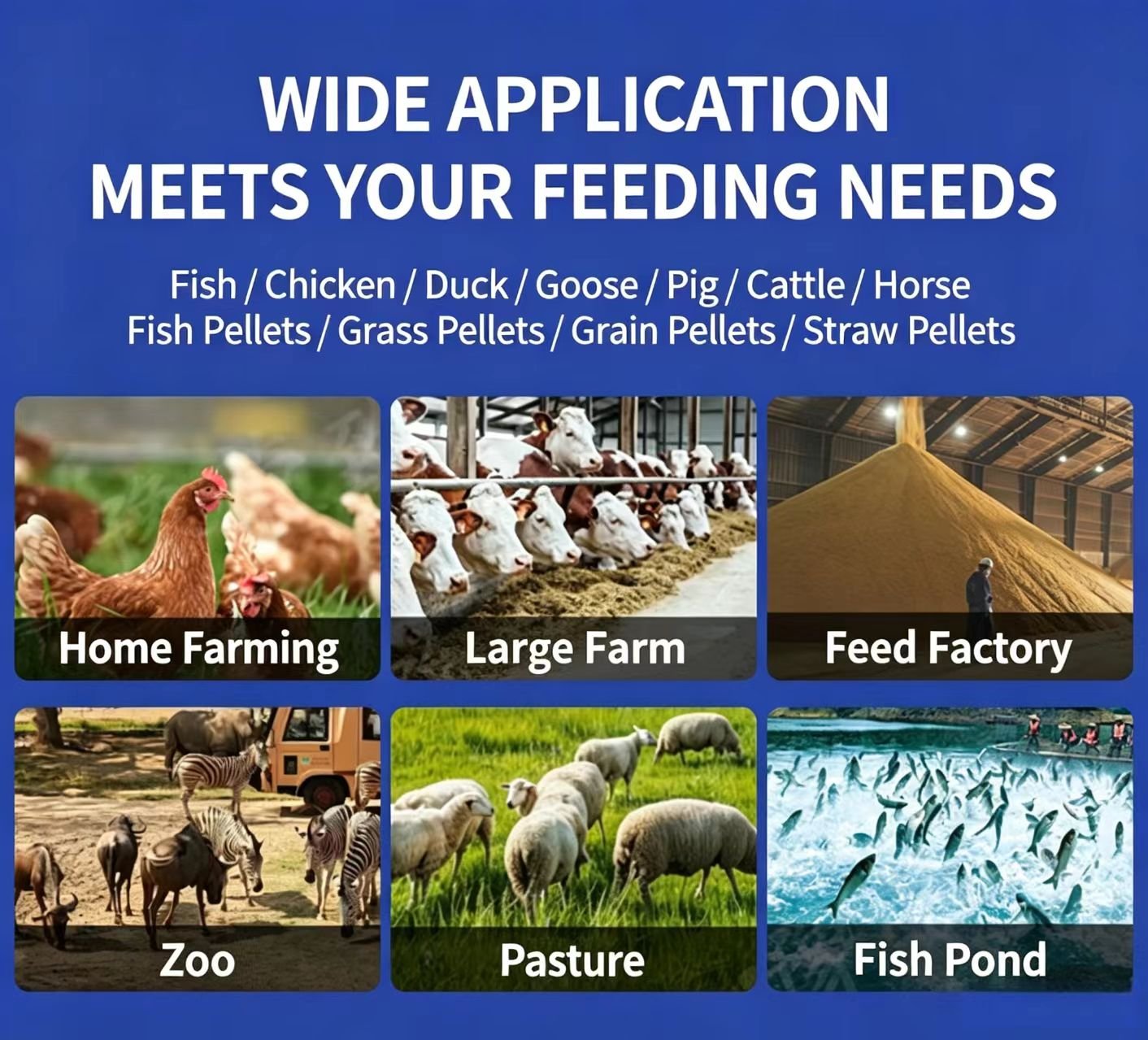
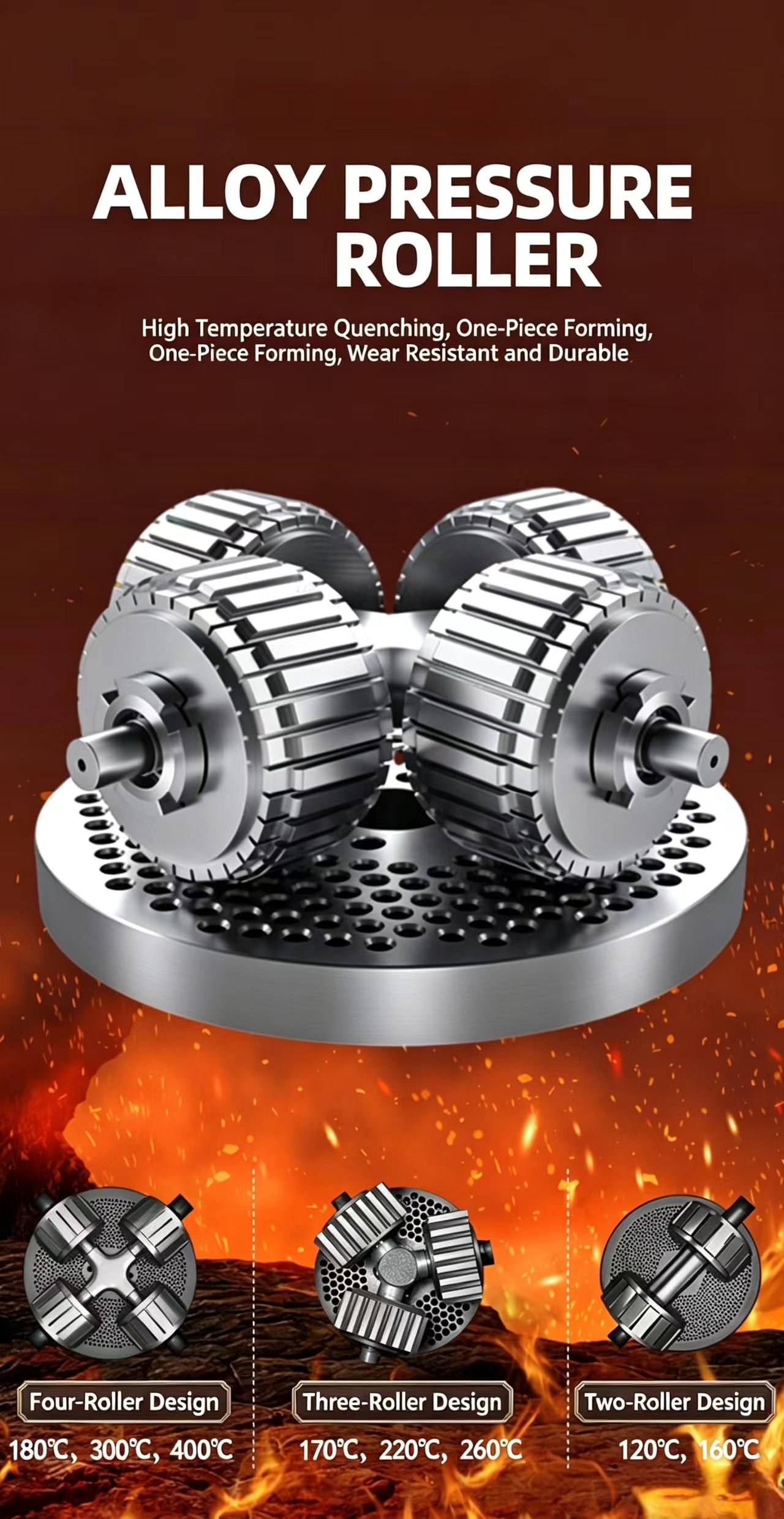
Because the KLJ machines take 3/4/6/8 mm dies, you can swap the die to suit chicks (3 mm), layers (4 mm) or cattle (6–8 mm) on the same body.
6. Match the Machine to Your Animals
Chickens & ducks
KLJ-150/160, 3–4 mm
Cattle, sheep, goats
KLJ-260, 6–8 mm
Rabbits & pigs
KLJ-210, 4–6 mm
Fish & shrimp
fine die, stable recipe
- Chickens & ducks: a small feed pellet machine for chicken (KLJ-150/160, 3–4 mm die) is plenty for a backyard-to-smallholder flock.
- Cattle, sheep & goats: larger 6–8 mm pellets at 350 kg/h+ (KLJ-260) handle roughage-rich rations.
- Rabbits & pigs: mid-range 4–6 mm pellets; the KLJ-210 is a common sweet spot.
- Fish & shrimp: use the fine die and a water-stable recipe; output is lower because the mix is finer.
7. Safety, Maintenance & Export
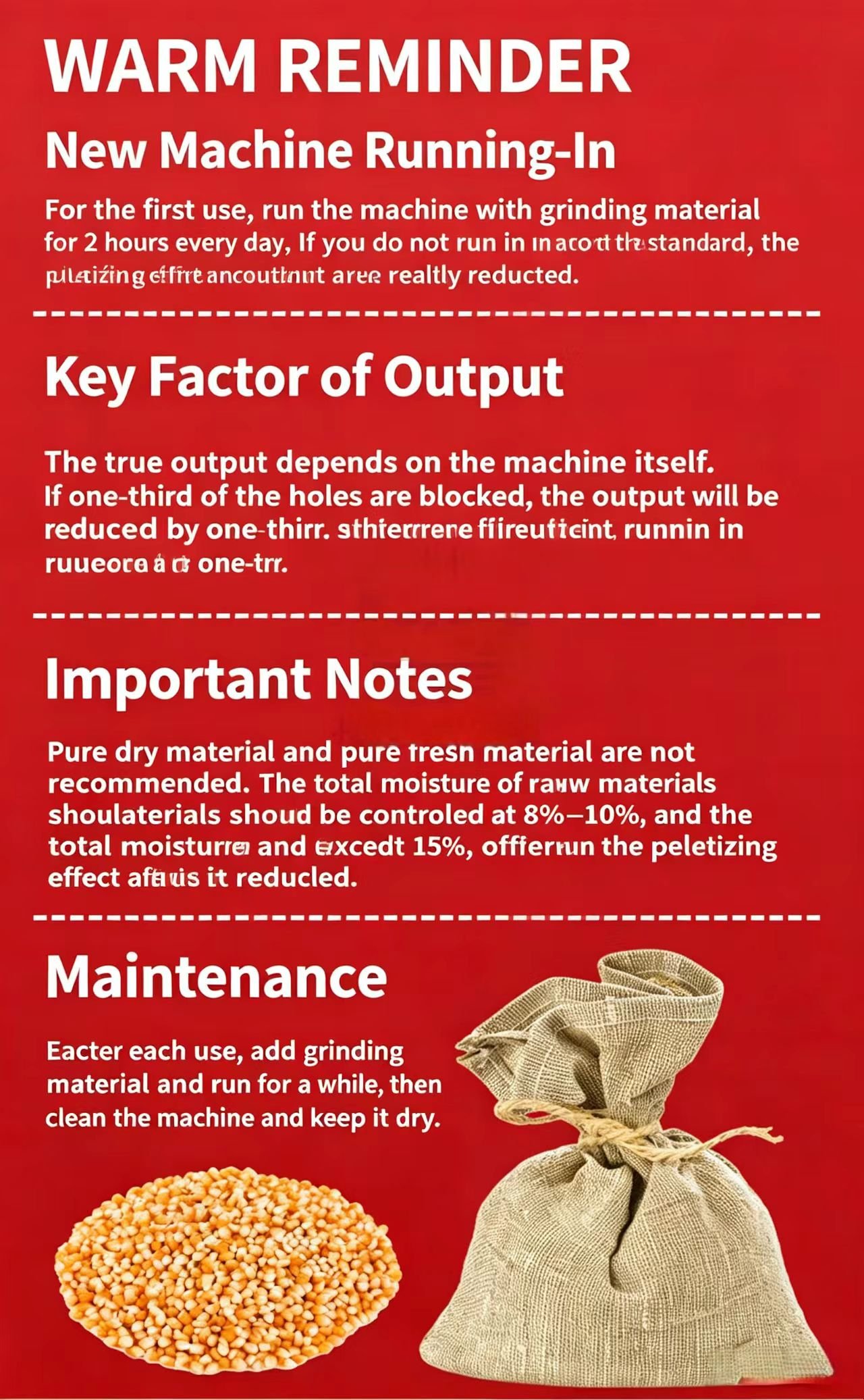
Keep output consistent by checking roller gap and die wear, greasing bearings per the manual, and running a break-in batch (oil + feed) on every new die. After each run, clear residual material so it cannot mould. For exporters, note the HS code for pellet machines is 84361000 — declare it on the commercial invoice so customs clearance goes smoothly.
If you need the maintenance checklist, spare rollers or die plates, our Sunto Service team ships parts worldwide.
Not Sure Which Pellet Mill Fits Your Farm?
Tell us your animals, daily volume and power supply — our team replies within 24 hours with specs and a factory-direct quote.
Contact Us