


South America Feedlot
TMR Mixing Time, Ingredient Order and Speed: A Practical Guide for South American Fattening Cattle
How long to mix, what order to load, and how mixing intensity should change by fattening stage - written for beef feedlots running a vertical TMR mixer across South America.
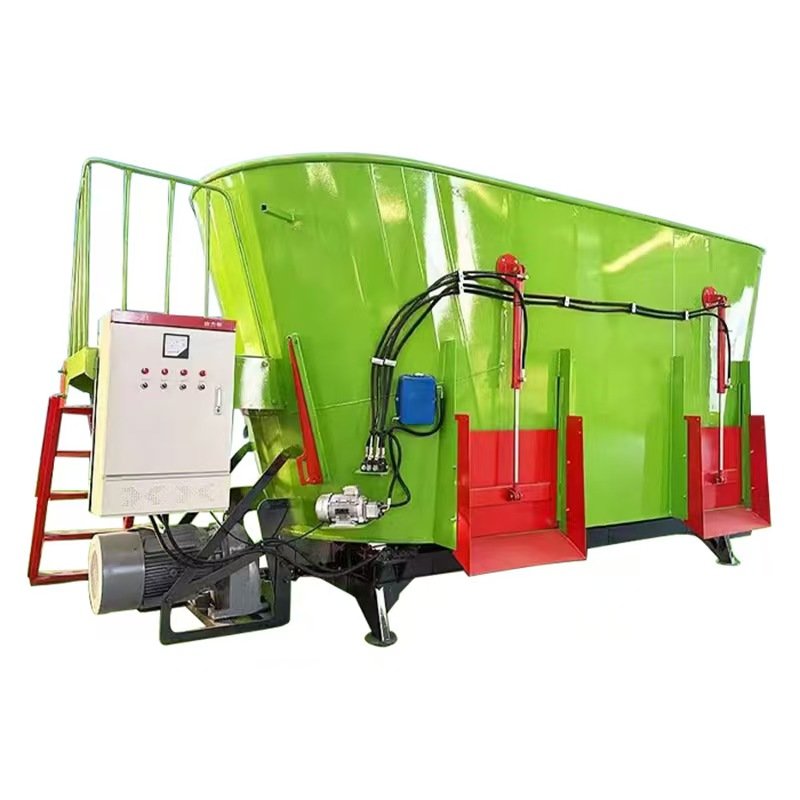
Why mixing method decides ration quality
A TMR only works if it is uniform. Mix it poorly and cattle sort out the tasty grain, waste feed and gain slower. Mix it right - correct time, order and speed - and you get an even ration, less waste and steady intake.
For South American feedlots, from the Argentina Pampas to the Colombia coffee zone, small mixing errors scale up fast across hundreds of animals. The three levers below are what operators actually control.
Mixing duration
After all ingredients are in the tub, a uniform mix usually takes 3-5 minutes. The full cycle including loading is roughly 15-20 minutes per batch.
You are done when: there are no whole ingredients left, the fibres look evenly coated, and there are no clumps or balls. Stop there. Over-mixing is a real mistake - it fines the particles, causes separation, heats the feed and loses nutrients.
These are general best-practice ranges. Follow the mixing time stated in your specific mixer manual.
Ingredient loading order
The order you load matters as much as the time. A reliable sequence for a vertical mixer:
- Chopped dry forage / hay first - the longest fibres go in first so the auger grabs and folds them.
- Silage / wet material - adds moisture and weight on top of the dry base.
- Grains and concentrates - maize, soybean meal, wheat bran and similar.
- Protein meals - added once the base is turning.
- Minerals, vitamins and liquids last - molasses, fat and additives go in last so they coat the mix evenly instead of pooling at the bottom.
In South America that often means regional feeds: maize, soybean meal, wheat bran, sugarcane tip, molasses (common in Brazil), citrus pulp and tropical grass silage. Loading liquids last is the single most-ignored step - do it and additive waste drops.

Mixing speed by fattening stage
As cattle move from receiving to finishing, the forage-to-concentrate ratio shifts hard toward grain. The mixing intensity and time should shift with it. The table below uses illustrative industry-common ratios - adjust to your nutritionist's formula:
| Stage | Forage:Concentrate (illustrative) | Mixing intensity | Time after load | Notes |
|---|---|---|---|---|
| Receiving / adaptation | 70:30 | Low | 4-5 min | High forage, easy to mix, gentle on the rumen |
| Growing | 55:45 | Low-Medium | 4-5 min | Balanced; watch moisture so it does not ball |
| Early finishing | 40:60 | Medium | 3-4 min | More grain; keep intensity moderate to avoid balling |
| Late finishing | 25:75 | Medium | 3-4 min | High grain; do not over-mix (separation, heat); liquids last |
The pattern: high-forage rations mix easily at lower intensity and can take a little longer; high-concentrate finishing rations risk grain "balling" and separation if you drive them too hard or too dry. Keep intensity moderate, add liquids last, and never over-mix. Note that auger RPM is set by the machine - what you control is sequence, duration and not over-driving. Confirm against your mixer manual.
Common mistakes
- Mixing too long - fines the feed and starts separation.
- Wrong order - dumping minerals or liquids in first so they pool instead of coat.
- Running too fast on high-moisture rations - balls form and cattle sort them out.
- Ignoring the manual - every tub size has its own target time and load limit.
Frequently asked
How do I know the mix is uniform?
Pull a sample from a few spots in the tub and the bunk. If fibre length and colour look the same everywhere and there are no clumps, it is mixed.
When should liquids like molasses go in?
Last. Add them after the dry and wet base is turning, with a little forage still in the tub to help the liquid coat evenly.
Does order differ between vertical and horizontal mixers?
The principle is the same, but the mechanics differ. See our vertical vs horizontal TMR mixer breakdown for the detail.
Does this apply to dairy cows too?
Yes - mixing time and loading order are universal. The stage table above is beef-fattening focused; dairy groups simply use their own ration ratios.
Related reading
Spec your South America mixer
Tell us your country, herd size, daily ration volume and power supply. We supply Spanish operation manuals and videos, and quote landed cost to your nearest port - Callao, Buenaventura, Valparaiso, Guayaquil and more.
Contact Sunto